
By Amit Lahoti, MD and Daniel B. Johnson
Medically Reviewed by Cal Murphy, PharmD, CSP, BCMTMS
Last Update: April 10, 2026
Refills are usually where things stop adding up. The prescription stays the same, but the price doesn’t – sometimes enough to make people delay the next order or start checking what that exact medication costs elsewhere.
That’s where Canadian Pharmacy Online starts getting attention. Not as a different treatment, just another way to keep the same one without dealing with constant price swings.
After that, the difference isn’t the idea itself, but how the pharmacy handles it. Some run a controlled process from prescription check to delivery. Others look fine at checkout but break down on verification, timing, or consistency. Most of that only becomes clear once the order is already in motion.
Contents:
- What Is a Canadian Pharmacy
- Legal & Safety
- How to Order
- Prescriptions
- Canada vs U.S.
- Why Prices Are Lower
- Prices & Savings
- Generics vs Brand
- Drug Shortages
- Popular Medications
- Bulk Orders & Refills
- Best Pharmacies
- How to Choose Safely
- How to Verify
- Shipping & Delivery
- Risks & Red Flags
- FAQ
- Conclusion
What Is a Canadian Online Pharmacy?
A Canadian online pharmacy works as a licensed service that fills medication orders through a website and delivers them directly to the patient. It works like a standard pharmacy in terms of prescription control and pharmacist oversight, but the entire process is handled remotely.
The process moves in a controlled, step-by-step sequence. The medication is selected, a valid prescription is submitted when required, and the pharmacy verifies the details before dispensing. Nothing is shipped until that check is complete. For non-prescription products, ordering is more direct, but the same dispensing standards still apply.
Most of these pharmacies operate as mail-order services rather than retail locations. The focus is on processing repeat prescriptions, maintaining steady supply, and shipping medications in secure, trackable packages. That structure is what makes them practical for long-term treatment rather than one-time purchases.
How Canadian Online Pharmacies Work
Orders follow a set path, and most reputable pharmacies handle it in a similar way. The pace depends more on verification than on how quickly the order is placed, which is why timing can vary slightly from one order to another.
The process starts with selecting the medication and confirming the correct dosage and quantity. For prescription drugs, a valid script must be provided before anything moves forward. This can be uploaded, sent by the doctor, or transferred directly to the pharmacy, depending on how the provider handles intake.
At that point, the request is reviewed. A licensed pharmacist checks the prescription, confirms the details, and makes sure the medication is appropriate before approving it. If something doesn’t match, the order is held until it’s clarified, which can add time but helps prevent mistakes.
Once approved, the provider prepares the medication for shipment. Orders are packaged securely and sent through standard international delivery, usually with tracking. Delivery depends on processing time, stock availability, and the selected shipping method, rather than how quickly the order was placed.
For repeat prescriptions, the process becomes easier after the first purchase. Details stay on file, which allows future refills to move through the same steps with fewer delays. That consistency is what makes this model work well for long-term treatment.
Who Uses Canadian Pharmacies (U.S. & International Buyers)
Canadian online pharmacies are widely used by:
- U.S. patients facing high drug costs
- Individuals without insurance or with high deductibles
- Patients managing chronic conditions requiring long-term medication
- Customers affected by local drug shortages or supply gaps
For many of these users, Canadian pharmacies provide access to the same active ingredients at significantly lower prices, making long-term treatment more manageable and consistent.
Is It Legal and Safe to Order from Canada in 2026?
For U.S. consumers, ordering prescription medication from a Canadian online pharmacy in 2026 falls into a limited enforcement area – but in practice, it remains a widely used and generally low-risk option when handled correctly.
Millions of Americans turn to Canadian pharmacies each year due to high domestic drug prices, especially for long-term treatments. While U.S. law technically restricts the import of prescription medications, enforcement is primarily focused on large-scale or unsafe shipments – not individuals purchasing small quantities for personal use.
U.S. Laws and FDA Position
The Food and Drug Administration states that importing prescription drugs from outside the United States is generally not permitted. However, the agency applies enforcement discretion, meaning it typically does not take action against individuals importing medications for personal use under specific conditions.
In practical terms, personal-use orders are allowed to proceed when they meet the following criteria:
- The medication is intended for personal use only
- The quantity does not exceed a typical 90-day supply
- The drug is not a controlled or restricted substance
- The product does not present an unreasonable health risk
For official guidance, you can review the FDA’s policy here: https://www.fda.gov/industry/import-basics/personal-importation
Personal Import Rules (90-Day Supply)
The 90-day supply guideline is widely accepted as the safest standard for cross-border orders. It reflects normal prescription use and signals to regulators that the purchase is for ongoing treatment – not resale or distribution.
Staying within this limit, and ensuring that your order matches your prescribed dosage, significantly reduces the likelihood of customs delays or shipment refusal. It also helps maintain a stable treatment schedule without interruptions.
Customs, Risks, and What to Expect
Medications shipped from Canada are reviewed by U.S. Customs and Border Protection as part of standard international processing. Packages that are clearly labeled and intended for personal use are delivered without issues.
Delivery times range from 1 to 3 weeks, depending on inspection volume, shipping method, and origin. Delays can happen if a package is selected for routine review or if documentation needs clarification, but these are usually temporary.
In rare cases, shipments may be returned or refused – most often when they exceed personal-use limits, contain restricted substances, or lack clear labeling. This is why reputable pharmacies keep quantities aligned with standard prescriptions and provide proper documentation.
For most patients ordering common medications, the process is predictable: delivery may take longer than domestic shipping, but it is generally reliable when using a transparent and licensed provider.
How to Order Drugs from a Canadian Pharmacy
Ordering medication from a Canadian online pharmacy follows a clear and structured process. Licensed providers are required to verify prescriptions, review each order, and ensure that medications are dispensed safely before shipping.
While the exact steps may vary slightly between pharmacies, the overall process is consistent and designed to be straightforward – even for first-time buyers. The sections below walk through each stage, from selecting a medication to completing your order and receiving delivery.
Step-by-Step Ordering Process
Ordering from a Canadian online pharmacy follows a structured process designed to verify prescriptions and ensure medications are dispensed safely. While it may feel more formal than a typical online purchase, each step helps prevent errors and ensures the correct treatment is delivered.

A standard order includes:
- Select the medication. Find the prescribed drug, choose the correct dosage, and select the quantity that matches your treatment plan.
- Create your account. Enter your contact and shipping details so the drugstore can process and deliver the order.
- Provide a valid prescription. Upload it online, send it by email or fax, or ask your doctor to forward it directly.
- Wait for verification. The pharmacy reviews the prescription, checks the order for accuracy, and confirms it meets safety requirements.
- Complete the payment. Once approved, finalize the purchase using the available payment methods.
- Receive your shipment. The provider prepares the order and ships it in discreet packaging, usually with tracking.
This process is consistent across most licensed pharmacies. Once your prescription and details are on file, future purchases are faster and easier to manage.
Payment Options and Order Confirmation
Once the prescription is approved, the order moves to the final step – payment and confirmation. At this stage, most pharmacies keep things fairly straightforward, focusing on secure processing rather than offering a wide range of options.
In practice, payment methods are usually limited to major credit cards, e-checks, or a small set of approved alternatives depending on the provider and location. Some options may not be available for international purchases, so it’s worth checking this before placing the order rather than at checkout.
After payment is submitted, the pharmacy issues a confirmation with the key details – medication, dosage, quantity, and shipping information. That’s where the order is considered finalized and prepared for dispensing.
Processing doesn’t always happen instantly. Verification, payment approval, and internal checks can take a short amount of time, so most orders move to the shipping stage within a few business days rather than immediately. Reliable pharmacies also send follow-up updates, and in many cases provide tracking once the package has been dispatched.
Prescription Requirements and Online Prescriptions in 2026
Prescription rules depend on the medication and the pharmacy, but most orders require verification before any drug is dispensed. Online pharmacies follow strict standards, even for international customers.
Do You Need a Prescription?
For most medications, the answer is yes. Canadian online pharmacies require a valid prescription before dispensing any prescription drug, even when the purchase is made online. This applies to treatments for chronic conditions, antibiotics, and other regulated medications.
Some products – such as certain over-the-counter drugs or low-dose treatments – may be available without a prescription. However, anything that normally requires a doctor’s approval in the United States will require one when ordered from Canada as well.
Reputable pharmacies do not bypass this requirement. If a website offers prescription drugs without asking for a prescription, it is a strong warning sign and should be treated with caution.
Telehealth and Online Prescription Options
Access to prescriptions has become more flexible in recent years, and many Canadian online pharmacies now work with telehealth providers. This allows patients to request a prescription or renew an existing one without visiting a doctor in person.
In practice, this usually means completing a short medical questionnaire or scheduling a remote consultation with a licensed physician. If approved, the prescription is issued and sent directly to the pharmacy for processing. This option is most commonly used for routine treatments, such as blood pressure, cholesterol, or men’s health medications.
Telehealth is not available for every case. New diagnoses, complex conditions, or medications with higher risk may still require an in-person visit. Even when telehealth is offered, the final decision depends on the reviewing doctor and the drugstore’s internal policies.
For patients who already have a valid prescription, telehealth is often unnecessary. However, it can be a practical option for renewals or situations where access to a local doctor is limited.
Using a U.S. Prescription in Canada
Many Canadian online pharmacies accept prescriptions issued by U.S. doctors, but this depends on the pharmacy and the type of medication. Often, a valid prescription from a licensed U.S. physician can be used, especially for common, long-term treatments.
Some pharmacies may require additional verification before processing the order. This can include confirming the doctor’s details, reviewing the prescription format, or requesting a new prescription issued by a Canadian-licensed partner physician. These steps are used to meet regulatory requirements and ensure the medication is appropriate.
For routine medications – such as treatments for blood pressure, cholesterol, diabetes, or thyroid conditions – U.S. prescriptions are typically accepted without major issues. However, controlled substances and certain specialized drugs are more likely to be restricted or declined.
If a prescription cannot be used directly, some pharmacies offer assistance through affiliated doctors who can review the request and issue a new prescription when appropriate.
Canada vs. U.S. Pharmacies: Key Differences
Canadian and U.S. pharmacies operate under different healthcare systems, which directly affects how medications are priced, approved, and accessed. While both countries maintain high safety standards, the overall experience for patients – especially in terms of cost and availability – can vary significantly.
In Canada, drug pricing is influenced by government regulation and national policies. In the United States, pricing is largely driven by private insurers and market forces, which often results in higher out-of-pocket costs for patients. This difference is one of the main reasons many Americans turn to Canadian pharmacies for more affordable options.
Access to medications can also vary. Canadian pharmacies tend to offer more consistent pricing, while U.S. patients often face fluctuations depending on insurance coverage, pharmacy networks, and location.
Drug Pricing Differences
The biggest difference between Canadian and U.S. pharmacies is the cost of medication. Prices for the same drug can vary significantly, even when the active ingredients and manufacturers are identical.
In Canada, prescription drug prices are influenced by government controls that limit how much pharmaceutical companies can charge. This creates more stable and predictable pricing across the country. In the United States, prices are largely set by manufacturers and negotiated with insurers, which often leads to higher retail costs – especially for patients without strong insurance coverage.
As a result, many common medications are noticeably cheaper when ordered from a Canadian pharmacy. This is particularly true for long-term treatments such as blood pressure medications, cholesterol drugs, diabetes therapies, and certain brand-name prescriptions.
The price gap is not always the same for every drug, but for many patients, the difference is large enough to make international ordering a practical option. Lower prices, combined with the ability to purchase larger supplies, can significantly reduce the overall cost of ongoing treatment.
Regulation and Approval Systems
Canada and the United States both enforce strict standards for approving and distributing medications, but the systems behind those processes are not identical.
In Canada, drugs must go through a centralized approval process before they can be sold. This includes a review of safety, effectiveness, and manufacturing quality. Once approved, medications are subject to ongoing monitoring to ensure they continue to meet national standards.
In the United States, the approval process is also rigorous, but it operates within a more complex system that includes federal oversight, private insurers, and pharmacy benefit managers. This can affect how quickly certain drugs reach the market and how they are priced once available.
Despite these structural differences, many medications sold in Canada and the U.S. come from the same global manufacturers. This means that, for a large number of commonly prescribed drugs, the core product remains the same even though the regulatory pathways differ.
Access, Insurance, and Availability
Access to medications differs noticeably between Canada and the United States, especially when insurance coverage is involved. In the U.S., many patients rely on private insurance plans to reduce costs, but coverage can vary widely depending on the provider, formulary restrictions, and pharmacy networks. This often means that the same medication may be affordable for one patient and expensive for another.
Canadian pharmacies operate in a more straightforward pricing environment. While insurance exists, many online pharmacies are used by customers paying out of pocket, particularly those ordering from outside Canada. Prices are listed upfront, which makes it easier to compare options and plan long-term treatment costs without depending on insurance approvals.
Availability can also vary between the two systems. Some medications may be easier to access in one country than the other due to supply conditions, approval timelines, or market demand. In certain cases, patients turn to Canadian pharmacies when a drug is temporarily unavailable or significantly more expensive in the United States.
For many U.S. patients, the appeal of Canadian pharmacies comes down to predictability – clear pricing, fewer insurance barriers, and consistent access to commonly prescribed medications.
Why Are Drugs Cheaper in Canada?
Medication prices in Canada are often lower than in the United States, even for the same drugs produced by the same manufacturers. This difference is not related to quality – it comes from how each country regulates pricing and controls access to medications.
In Canada, drug prices are influenced by national policies that limit how much manufacturers can charge. These limits apply across the market, which helps keep prices more consistent and prevents large price increases over time. In contrast, the U.S. system allows companies to set prices more freely, with costs often shaped by negotiations between manufacturers, insurers, and pharmacy benefit managers.
Another factor is how medications are purchased and distributed. Canadian pharmacies often operate within a more controlled supply system, while the U.S. market includes multiple intermediaries that can increase the final price paid by patients.
For people paying out of pocket – especially those without strong insurance coverage – these differences can lead to noticeable savings. This is particularly true for long-term treatments, where even small price gaps add up over time.
Government Price Controls
One of the main reasons drug prices are lower in Canada is direct government oversight. Unlike the United States, where pharmaceutical companies have significant freedom to set prices, Canada applies limits that restrict how high those prices can go.
Before a medication is widely sold, its price is reviewed against several benchmarks, including its therapeutic value and how it compares to similar drugs already on the market. This prevents new medications from being introduced at inflated prices without justification.
Price increases are also restricted. Manufacturers cannot raise prices freely over time without facing review, which reduces the kind of gradual cost escalation often seen in the U.S. market.
Because of these controls, pricing tends to stay within a narrower range. The same medication is less likely to vary dramatically between pharmacies, and sudden price spikes are uncommon.
Bulk Purchasing and Supply Chains
Canada’s pricing advantage is also tied to how medications move through the system. Pharmacies and suppliers often deal with larger, more centralized orders, especially for high-demand drugs.
That scale changes pricing. When medications are purchased in higher volumes, the cost per unit drops, which makes it easier for pharmacies to offer lower retail prices. This is especially noticeable for long-term treatments that are consistently restocked.
The structure of the supply chain also plays a role. In the U.S., medications often pass through multiple intermediaries before reaching the patient, and each step can add cost. In Canada, the path is typically more direct, which reduces the number of markups along the way.
The result isn’t just lower prices – it’s fewer pricing layers between the manufacturer and the end user.
Differences in Marketing and Healthcare Systems
In the United States, prescription drugs are marketed like consumer products. Pharmaceutical companies promote brand-name medications directly to patients through TV, online ads, and sponsored content. That level of promotion is expensive, and those costs are built into the final price of the drug.
Canada does not follow the same model. Direct-to-consumer advertising for prescription medications is highly restricted, which removes a major cost driver from the system. As a result, pricing is less influenced by branding and more by regulatory limits and market controls.
The structure of the healthcare system also affects how medications are priced. In the U.S., multiple private players – insurers, pharmacy benefit managers, and distributors – each play a role in determining what a patient pays. Every step can introduce additional costs or pricing adjustments.
In Canada, the system is more centralized and regulated. There are fewer commercial layers involved, and pricing decisions are less tied to competition between private companies. This reduces the number of price adjustments between the manufacturer and the patient.
These differences don’t change the medication itself, but they do explain why the same drug can be priced very differently depending on where it’s purchased.
Canadian Pharmacy Prices: Comparison and Savings
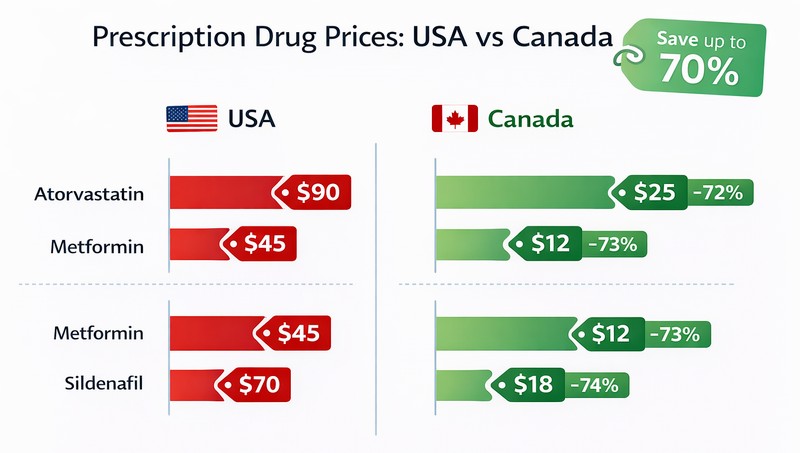
Price differences between Canadian and U.S. pharmacies become more noticeable when you compare specific medications side by side. For many commonly prescribed drugs, the gap is not small – it can be significant, especially without insurance coverage.
Canadian online pharmacies typically list prices upfront, which makes it easier to see the total cost before ordering. In contrast, U.S. pricing often depends on insurance plans, discounts, or pharmacy networks, so the final price can vary from one patient to another.
Savings are most visible with long-term treatments. Medications taken daily over months or years – such as those for blood pressure, cholesterol, or diabetes – tend to show the largest difference in total cost over time.
Price Comparison Table
Actual savings become clearer when you compare specific medications. While prices vary by pharmacy, dosage, and brand vs. generic versions, the difference between Canada and the United States is often noticeable for commonly prescribed drugs.
| Medication | U.S. Price (avg) | Canada Price (avg) | Potential Savings |
|---|---|---|---|
| Atorvastatin (Lipitor) | $70-$120 | $25-$50 | 40-70% |
| Metformin | $30-$60 | $10-$25 | 50-70% |
| Lisinopril | $40-$80 | $15-$30 | 50-65% |
| Sildenafil (Viagra) | $200-$400 | $70-$150 | 50-70% |
| Levothyroxine | $25-$50 | $10-$20 | 40-60% |
Prices shown are approximate and depend on dosage, quantity, and supplier. Generic versions are usually where the largest savings are seen, especially for long-term use.
How to Get the Lowest Prices
Prices can vary even within Canadian online pharmacies, so a few small choices can make a noticeable difference over time.
To reduce costs, focus on the following:
- Compare the same medication across multiple pharmacies
- Choose generic versions when available
- Order a 90-day supply instead of smaller quantities
- Check if dosage adjustments allow safe tablet splitting
- Stick with one pharmacy for easier refills and pricing consistency
These steps don’t change the medication itself, but they can significantly lower the total cost of long-term treatment.
Generic vs Brand Medications: What to Choose
Generic and brand-name medications are both widely used, but they are not always viewed the same by patients. The difference goes beyond price and often raises questions about effectiveness, consistency, and when one option may be preferred over the other.
Are Generics as Effective?
In most cases, yes. A generic medication is expected to work the same way as the brand-name version because it contains the same active ingredient and is approved for the same use. It must also match the original drug in strength, dosage form, and route of administration.
Clinical research has consistently shown that approved generics deliver comparable therapeutic results for the majority of commonly prescribed medications.
What can differ is everything around that active ingredient. The tablet may look different, the inactive ingredients may vary, and the packaging may come from another manufacturer. That is why some patients notice changes in appearance or minor differences in how the medication feels, even when it is considered equivalent.
For most routine treatments – such as blood pressure, cholesterol, or diabetes – these differences do not affect the outcome. In some cases where dosing must remain very consistent, doctors may recommend staying with the same version to avoid variability.
Price vs Performance Differences
For most medications, the difference in price between generic and brand-name drugs is significant – but the difference in results is usually minimal.
Generic drugs are required to match the original medication in active ingredient, dosage, and effect. In practical terms, this means a generic blood pressure drug or cholesterol medication will lower levels in the same way as the brand-name version. For routine conditions, patients rarely notice any difference in how the medication works.
Where differences can matter is in how the drug is delivered. Some brand-name medications use specific formulations, coatings, or release mechanisms that affect how the drug is absorbed. This is more relevant for medications such as extended-release treatments, thyroid drugs, or certain neurological medications, where small variations can affect stability or consistency.
Another factor is consistency between refills. Generic medications may come from different manufacturers over time, which can lead to slight variations in inactive ingredients. While this does not change the core effect, some patients prefer staying on the same version to avoid any noticeable differences.
In everyday use, generics are the standard choice because they deliver the same outcome at a lower cost. Brand-name drugs are typically used when a specific formulation is required or when a patient has already responded well to a particular version and wants to stay consistent.
Drug Shortages and Available Alternatives
Medication shortages have become more common in recent years, affecting both the United States and Canada. Supply disruptions, manufacturing delays, and increased demand can all limit the availability of certain drugs, sometimes without much warning.
For patients, this can mean delays in treatment or difficulty finding a specific medication at the usual pharmacy. In some cases, a drug may be temporarily unavailable in one country while still accessible through alternative suppliers or international pharmacies.
Because of this, flexibility becomes important. When a specific medication is out of stock, doctors and pharmacists may recommend switching to a different brand, a generic equivalent, or a similar drug within the same class.
Common Shortages in 2026
Drug shortages in 2026 continue to affect a wide range of medications, especially those that rely on complex manufacturing or have limited suppliers. While not every shortage impacts all patients, certain categories appear more frequently across both the U.S. and Canada.
One of the most visible issues has been with hormone therapies, particularly estrogen patches, where demand has increased sharply in recent years, leading to ongoing supply gaps.
Stimulant medications used for ADHD, such as methylphenidate-based treatments, have also experienced recurring shortages linked to global supply chain disruptions and manufacturing limits.
Other commonly affected categories include:
- Pain medications (including opioid combinations and injectable analgesics)
- Antibiotics and antifungals (e.g., fluconazole, moxifloxacin)
- Emergency medications like epinephrine and injectable hospital drugs
- Chronic condition drugs, including insulin and certain cardiovascular treatments
In Canada alone, there are often over 1,500 active drug shortages at any given time, reflecting how widespread and ongoing the issue has become.
Most shortages are not permanent, but they can last weeks or even months depending on production capacity and demand. As a result, patients are often required to switch medications, adjust dosages, or look for alternative suppliers during these periods.
Safe Substitutes and Switching Options
When a medication is unavailable, switching to an alternative is often a practical solution – but it should be done carefully and with the right guidance.
In many cases, a direct substitute exists. This can be a generic version of the same drug or a different brand containing the same active ingredient. These options are usually the simplest, since they are designed to deliver the same effect and require minimal adjustment.
When an exact match is not available, doctors may recommend a medication from the same drug class. These drugs work in a similar way but may differ slightly in dosage, timing, or side effects. For example, one cholesterol medication may be replaced with another statin, or a different type of blood pressure drug may be used to achieve the same result.
Switching becomes more complex with medications that require precise dosing or stable blood levels. In those cases, even small changes can affect how the body responds, so adjustments should always be monitored. This is especially relevant for treatments involving hormones, neurological conditions, or extended-release formulations.
The safest approach is simple: never switch medications on your own. A pharmacist or doctor can confirm whether an alternative is appropriate, adjust the dosage if needed, and ensure the new medication fits your treatment plan.
Most Popular Prescription Drugs in 2026
Prescription drug demand in 2026 is shaped by long-term treatment needs and a few consistently high-interest categories. Instead of shifting rapidly, usage remains stable, with the same types of medications appearing across most orders.
What stands out is not just what patients buy, but how they buy it. Medications used for ongoing conditions continue to dominate, while a smaller group of treatments – especially those tied to quality of life – generate strong, repeat demand.
Some of the most commonly requested drugs include:
- Cholesterol medications such as atorvastatin
- Blood pressure treatments like lisinopril
- Diabetes medications including metformin
- Thyroid hormone replacements
- Men’s health treatments such as Viagra (sildenafil) and Cialis (tadalafil)
These medications are widely used, often prescribed for long periods, and often available in generic form. That combination makes them more accessible and easier to manage through online pharmacies.
Rather than short-term trends, the list reflects steady demand. Patients tend to return to the same medications over time, which is why pricing, availability, and refill simplicity matter more than brand recognition.
Bulk Orders and Subscription Savings
Ordering patterns play a major role in how much patients spend over time. Beyond comparing prices between pharmacies, the way an order is structured – quantity, timing, and refill approach – can noticeably affect the final cost per dose.
Instead of making frequent small puchases, many patients shift toward fewer, more predictable refills. This reduces variability in pricing and helps avoid gaps in treatment. Over time, this approach becomes less about individual purchases and more about maintaining a stable, repeatable routine.
Some pharmacies also support ongoing refill setups, which simplify the process for long-term medications. These options are not always presented as formal subscriptions, but they serve a similar purpose: keeping treatment consistent while reducing the need to restart the ordering process each time.
90-Day Supply Benefits
Larger orders are priced more efficiently than smaller ones. When medication is purchased in higher quantities, the cost per unit often drops, even if the total price of the purchase is higher.
This approach also reduces the impact of fixed costs such as shipping and processing. Instead of paying these costs multiple times for smaller purchases, they are applied once to a larger supply, which improves overall value.
For long-term treatments, this becomes a practical way to manage both cost and continuity. Fewer orders mean fewer chances of delays, and a steady supply helps maintain consistent treatment without interruption.
Subscription and Refill Programs
For patients using ongoing medication, refill programs can make the process more predictable. Some pharmacies allow orders to be repeated based on existing prescriptions, reducing the need to re-enter information or resubmit documents each time.
These setups are especially useful for treatments that do not change frequently. Instead of manually placing each order, patients can follow a more routine schedule, which helps avoid missed refills or last-minute ordering.
While not every pharmacy offers a formal subscription model, many provide similar functionality through account-based reordering, reminders, or saved prescriptions. The result is a smoother, more consistent experience for long-term use.
Best Canadian Online Pharmacies
By 2026, a small group of Canadian online pharmacies continues to stand out for consistent order fulfillment, transparent pricing, and stable supply of high-demand medications. While many sites offer similar products, differences in reliability, shipping performance, and prescription handling are where the gap becomes clear.
The pharmacies listed below are selected based on recent performance factors – order consistency, pricing stability, and overall user experience – not just name recognition.
Quick comparison
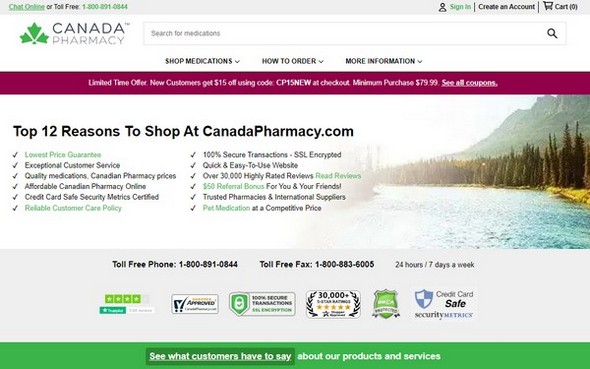
- Canada Pharmacy – Best for stable pricing and long-term use
- NorthWest Pharmacy – Best for reliability and consistent delivery
- Canada Drugs Direct – Best for lower prices on common medications
- Canada Pharmacy Online – Best for balanced pricing and routine refills
- Canada Drug Warehouse – Best for maximum savings (with some variability)
- RxConnected – Best for structured ordering and thorough verification
- Canada Cloud Pharmacy – Best as an alternative option for availability checks
Canada Pharmacy
 Canada Pharmacy is a strong fit for long-term prescriptions where stable pricing matters more than chasing short-term discounts. Instead of frequent price swings, it offers a more fixed cost structure across repeat purchases, which makes it easier to manage ongoing treatments. The catalog is broad, covering both brand and generic medications, with consistent availability for commonly used therapies.
The service stands out for its flexible shipping model, including per-order fees and optional annual or lifetime shipping plans, which can reduce costs for regular users. Orders may be fulfilled through licensed partner pharmacies in Canada and internationally, helping maintain stock during shortages. Delivery is predictable rather than fast, so it works best for planned refills and patients who prioritize consistency over speed.
Northwest Pharmacy
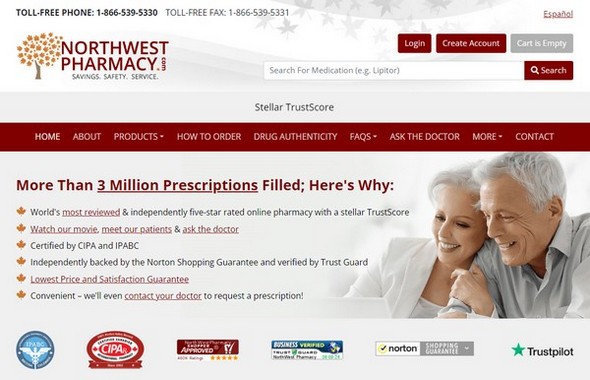
 Northwest Pharmacy is a reliable option for repeat prescriptions and long-term treatments where consistency matters. The ordering process follows a clear structure, with careful prescription verification that often includes direct confirmation with the prescriber. This reduces errors and keeps the overall experience predictable from one order to the next.
Delivery timelines are steady rather than fast, which makes it better suited for planned refills than urgent needs. Medications may be sourced through licensed pharmacies in Canada and approved international partners, helping maintain availability across common prescriptions. This setup works well for patients who prefer a stable, low-friction experience instead of constantly comparing prices or switching providers.
Canada Drugs Direct
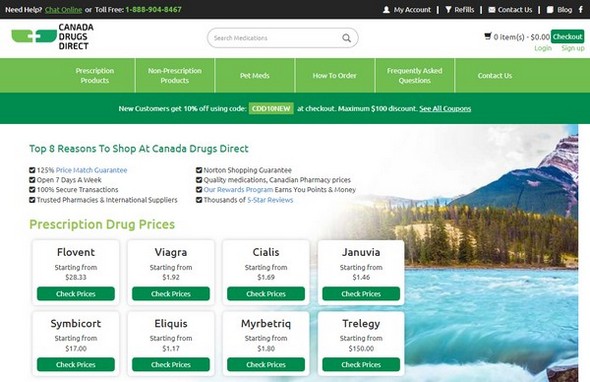
 Canada Drugs Direct is a price-focused option for users looking to reduce costs on common medications, especially generics. The platform often lists lower prices compared to more established providers, making it appealing for routine prescriptions where savings add up over time. It also includes a price match policy, which helps keep costs competitive across frequently purchased drugs.
The service is more focused on affordability than speed or premium support features. Delivery times are moderate, and availability can vary depending on the medication and source pharmacy. The site includes standard security measures and a rewards program for repeat purchases, which adds small savings over time. Ideal for budget-conscious users comfortable organizing orders in advance.
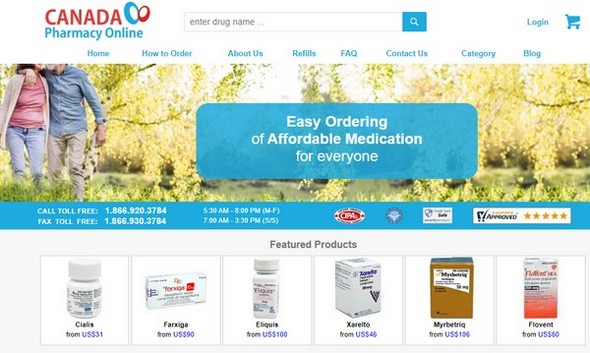
Canada Pharmacy Online
 Canada Pharmacy Online is a balanced option for users who want reasonable pricing without sacrificing overall consistency. Prices are often competitive on commonly prescribed medications, especially generics, but the platform does not focus exclusively on being the cheapest. Instead, it offers a more stable mix of cost, availability, and simplicity.
Delivery times and pricing can vary slightly depending on supply and fulfillment source, but the experience stays steady across regular refills. The platform supports standard prescription processing and maintains a steady catalog across popular treatments. Works well for users who want consistency without switching providers.
Canada Drug Warehouse
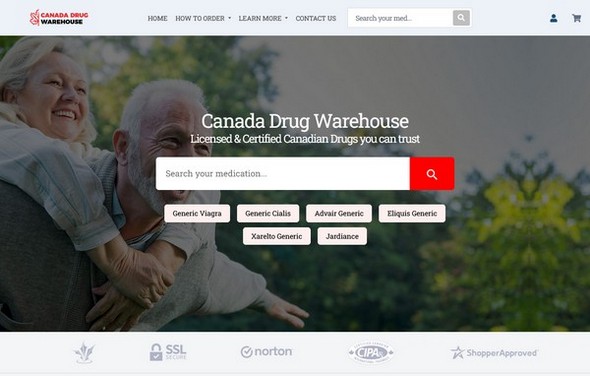
 Canada Drug Warehouse is geared toward deep discounts, especially on larger quantities and long-term prescriptions where bulk ordering reduces the cost per unit. It often lists noticeably lower prices on common medications, which makes it appealing for users trying to stretch their budget over time.
That advantage comes with trade-offs. Stock can change depending on sourcing, and fulfillment may involve different partner pharmacies, which can affect both delivery speed and consistency between orders. It works best for users who are comfortable planning ahead and prioritizing savings over a perfectly uniform experience.
RxConnected
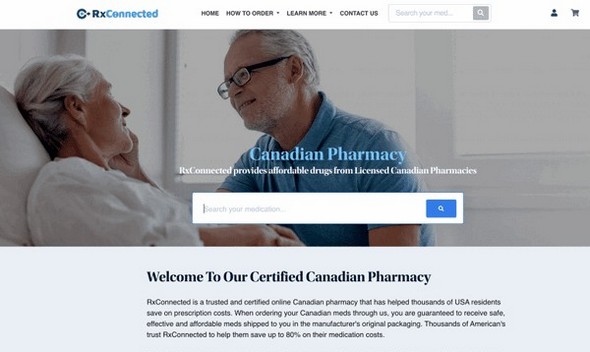
 RxConnected is a verification-first platform that prioritizes accuracy over speed. It reviews prescriptions step by step and often contacts the prescriber directly when needed. This approach takes more time, but it reduces errors and keeps each order aligned with the original prescription.
The process moves slower, especially for first-time purchases, but follows a clear path from submission to shipment. Licensed pharmacies supply the medications, with a strong focus on documentation and consistency. This approach suits users who prefer more control over each step and are comfortable waiting a bit longer for a more structured verification process.
Canada Cloud Pharmacy
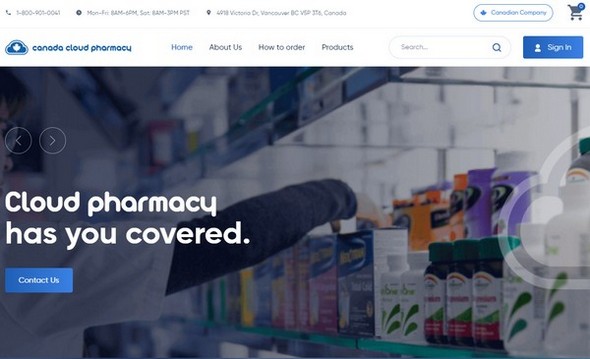
 Canada Cloud Pharmacy is best used as an additional option when checking availability across multiple sources. Instead of focusing on one fixed supply channel, it helps surface medications that may be out of stock or priced differently elsewhere. It’s a useful option for harder-to-find prescriptions or when standard choices aren’t consistently available.
The experience can vary depending on the source pharmacy, so pricing, fulfillment, and delivery timelines are not always uniform. For that reason, it’s better suited as a secondary check rather than a primary provider. This setup works well for users who want to compare options or locate specific medications that are not consistently available through larger platforms.
How to Choose a Safe Online Pharmacy
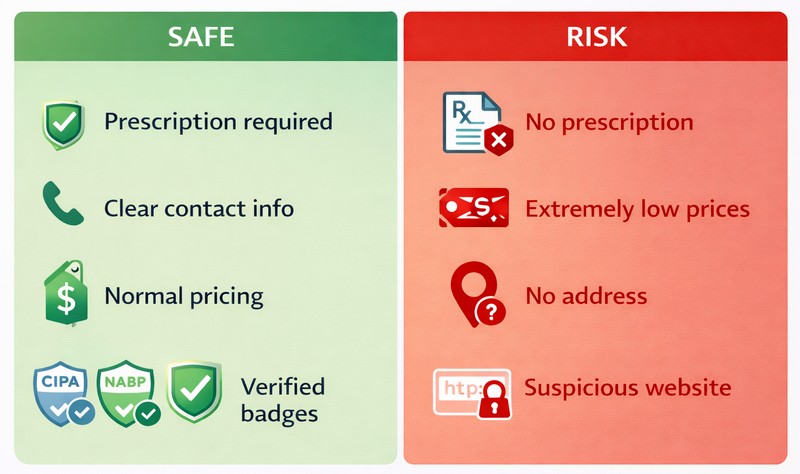
Picking a Canadian online pharmacy should never come down to price alone. A lower total can look attractive, but safety matters more than saving a few extra dollars. The right service makes the process clear from the start: it explains prescription rules, shows real contact details, and does not hide how orders are reviewed or shipped.
A safe provider also acts like a drugstore, not like a discount marketplace. It asks for a valid prescription when one is required, lists medication details clearly, and gives customers a direct way to reach support. When those basics are missing, the risk goes up fast. A good platform should feel transparent, consistent, and easy to verify before you place any order.
Key Safety Criteria
A safe Canadian online pharmacy is easy to recognize once you know what to look for. The most reliable sites don’t hide details or simplify the process too much – they follow a clear structure and show exactly how orders are handled.
Start with what you can verify directly:
- Prescription required before approval. A proper provider will not process prescription drugs without reviewing a valid script. If checkout happens before verification, that’s a problem.
- Visible business identity. The site should clearly display a real company name, physical address, and working contact details. You should know who is behind the service.
- Consistent product details. Each medication page should include dosage, quantity, and manufacturer. Vague listings or missing information make it harder to trust what will be delivered.
- Standard ordering flow. The process should follow a logical sequence – select medication, submit prescription, wait for review, then pay. If steps are skipped or rearranged, it signals poor control.
- Secure website and payment handling. The site should load over HTTPS and use familiar payment methods. Unusual payment instructions or redirects are a warning sign.
- Accessible customer support. There should be a clear way to contact support and get a real response. Reliable pharmacies don’t rely only on automated replies.
These checks don’t take long, but they filter out most unsafe options. A legitimate pharmacy makes everything visible upfront, without forcing you to dig for basic information.
Warning Signs of Fraudulent Pharmacies
Risky online pharmacies often look convincing at first glance. The difference shows up in small details – how they handle prescriptions, how much information they hide, and how aggressively they push a sale.
Watch for these red flags:
- No prescription required. This is the clearest warning. Any site offering prescription drugs without asking for a valid script is operating outside normal standards.
- Prices that don’t make sense. Extremely low prices can look appealing, but they often signal poor sourcing or counterfeit products. Real pharmacies compete on price, but they don’t drop far below the market without a reason.
- Missing or vague contact details. No physical address, no working phone number, or generic contact forms only. If you can’t identify the business, you can’t verify it.
- Unclear product descriptions. Listings without dosage, manufacturer, or proper labeling create uncertainty about what will actually arrive.
- Unusual payment methods. Requests for cryptocurrency, wire transfers, or payment outside standard checkout systems increase risk and reduce buyer protection.
- Pushy or misleading messaging. Claims like “no prescription needed,” “instant approval,” or guaranteed results are not typical of legitimate pharmacies.
- Inconsistent website behavior. Broken pages, mismatched product information, or sudden redirects during checkout suggest poor control or a cloned site.
A single issue may not always confirm fraud, but multiple red flags together are a strong signal to stop. Safe pharmacies don’t rush the process or hide details – they make verification easy before you commit to an order.
How to Verify a Legitimate Canadian Pharmacy
A legitimate Canadian pharmacy can be confirmed in a few minutes using independent sources. What a site claims about itself is not enough – real verification comes from external checks.
Several trusted tools allow you to confirm licensing, oversight, and operating standards. The sections below show where to look and how to verify a pharmacy.
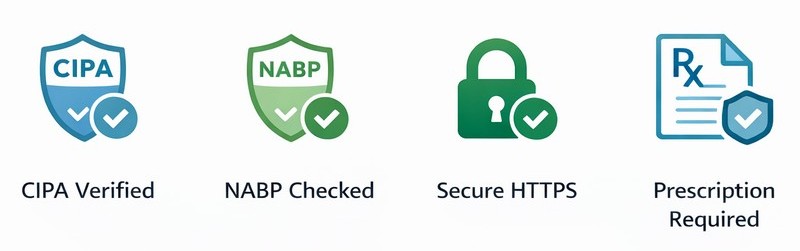
Canadian International Pharmacy Association (CIPA)
 One of the quickest ways to verify a Canadian online pharmacy is to check whether it is listed by Canadian International Pharmacy Association. This organization maintains a public database of approved members that meet strict safety, licensing, and dispensing standards.
A valid CIPA listing confirms that the pharmacy:
- requires prescriptions for regulated medications
- operates through licensed pharmacists
- follows verified sourcing and safety practices
Verification is simple. Go to the official CIPA website and use the “Verify a Pharmacy” tool. Enter the provider name or website URL. If the drugstore is listed, it means it has passed ongoing compliance checks. If it does not appear, the claim should be treated with caution.
CIPA membership is one of the strongest trust signals, but it should still be combined with other checks. Some fraudulent sites copy logos or make false claims, so always confirm directly through the official database rather than relying on badges shown on the platform’s homepage.
National Association of Boards of Pharmacy / Safe.Pharmacy
 Another reliable way to check a pharmacy is through National Association of Boards of Pharmacy, which runs the Safe.Pharmacy verification program. This tool focuses on whether an online service meets accepted safety and legal standards, especially for U.S. patients.
The Safe.Pharmacy database allows you to search a website and see if it is:
- approved or verified
- not recommended or flagged
- operating outside standard pharmacy practices
This check is useful because it goes beyond what a service claims. It reflects independent review criteria, including prescription handling, licensing transparency, and patient safety requirements.
To verify a pharmacy, visit the Safe.Pharmacy site and enter the domain name. If the platform appears in the “Not Recommended” list, it’s best to avoid it. If it is verified or not flagged, it adds another layer of confidence.
NABP verification works well alongside other checks. It gives a clear signal about how a drugstore operates from a regulatory and safety perspective, rather than just how it presents itself online.
National Association of Pharmacy Regulatory Authorities

National Association of Pharmacy Regulatory Authorities connects provincial pharmacy regulators across Canada and helps confirm whether a pharmacy operates under a valid license. Unlike consumer-facing tools, this check focuses on the regulatory side behind the website.
Every legitimate Canadian online pharmacy must be linked to a licensed physical drugstore within a specific province. That license is issued and monitored at the provincial level, not by the website itself.
To verify this:
- identify the pharmacy’s stated province
- check the corresponding provincial regulator
- confirm the dispensing pharmacy is registered
If a site does not clearly state where it is licensed, verification becomes difficult – and that alone is a concern.
This step adds depth to your checks. It confirms that the pharmacy is part of a regulated system, not just an online storefront.
Health Canada
 Health Canada does not operate as a public “search tool” like other verification platforms, but it still plays a key role in confirming legitimacy. Every approved medication in Canada is tied to a regulated system that tracks its formulation, manufacturer, and approval status.
For users, this matters at the product level. A legitimate pharmacy should provide enough detail to identify the medication clearly – name, strength, and manufacturer. That information can then be matched against official drug records to confirm that the product exists within the regulated system.
Another practical check is consistency. Packaging, labeling, and documentation should align with standard pharmaceutical formats. Missing details, unusual labeling, or unclear product origin can signal problems, even if the website itself appears legitimate.
This step works as a final layer of verification. It confirms that not only the provider, but also the medication itself fits within a regulated and traceable system.
Shipping, Delivery, and Customs Information
Shipping from a Canadian online pharmacy follows a predictable pattern, but timing and delivery details depend on the provider, location, and shipping method selected. Most orders move through international processing, which adds a layer of variability compared to domestic delivery.
For U.S. customers, packages typically pass through customs before final delivery. In many cases, smaller personal-use shipments move without issues, especially when they match standard prescription quantities. Delivery time can still vary depending on inspection flow and shipping speed.
Delivery Times to the U.S.
Delivery to the U.S. follows a consistent pattern once the order is approved. Pharmacies take a few business days to review the prescription, confirm stock, and prepare the shipment, so the timeline starts after verification rather than at checkout.
Most orders arrive within 7 to 14 business days with standard shipping. Faster options can shorten delivery to 3 to 7 business days, although availability depends on the pharmacy and the specific medication. Even with express services, international shipping still involves multiple handoffs, which can affect timing slightly.
Customs is part of the route, but small personal-use shipments pass without issues. Short delays can happen during inspection, especially during busy periods, but extended holds are not typical for regular refills.
Tracking usually updates after dispatch. It may appear inactive while the package is in transit between countries, then resume once it reaches the U.S. delivery network.
Packaging and Discretion
Most Canadian online pharmacies use plain, discreet packaging for delivery that does not reveal what’s inside. Deliveries arrive in simple envelopes or small boxes without product names or pharmacy branding on the outside, so nothing stands out during transit or at delivery.
Inside, the approach is more standard. Medications are sealed and labeled with key details such as name, strength, and manufacturer, often in original blister packs or manufacturer packaging. This helps protect the product during shipping and keeps information clear once the package is opened.
Order paperwork is placed inside rather than attached to the exterior. Some pharmacies include only basic details, while others provide a full packing slip, but without exposing sensitive information on the outside.
Lost or Delayed Orders
Delays happen from time to time, even when everything is handled correctly. A package can sit longer than expected at one stage of the route, especially during customs checks or busy shipping periods.
Tracking doesn’t always reflect real movement. It can stay unchanged for several days while the shipment is still in transit, then update again once it reaches the U.S. system. That gap often looks worse than it is.
If there is no update for an extended period – usually beyond the expected delivery window – it makes sense to contact the pharmacy. Reliable providers set a clear point when an order is considered lost and offer a replacement or refund, while weaker sites often delay or avoid resolution.
Risks and Red Flags When Buying Online
Buying medication online can work well when the pharmacy follows proper standards, but the difference between reliable providers and risky sites is still significant. Most issues don’t come from the ordering process itself – they come from weak controls, unclear sourcing, or skipped verification steps.
Some websites look convincing but operate without proper oversight. They may avoid prescription checks, provide limited product details, or rely on unclear supply chains. These problems are not always obvious at first glance, which makes careful evaluation important before making a purchase.
Fake Pharmacies and Counterfeit Drugs
Fake pharmacies remain one of the biggest risks when ordering medication online. Some operate as simple storefronts that collect payments without delivering anything. Others ship products that look legitimate but come from unclear or unverified sources.
Counterfeit drugs are not always easy to spot. Packaging can look convincing, and product pages often reuse real images and descriptions. The issues show up in smaller details – missing manufacturer information, inconsistent labeling, or unclear batch and expiry data. In some cases, the medication may contain the wrong dosage or different active ingredients altogether.
A careful check of both the pharmacy and the product listing reduces most of this risk. Legitimate providers keep sourcing and labeling consistent, while unreliable sites tend to avoid clear answers about where medications come from.
“No Prescription” Warning Signs
A pharmacy that offers prescription medication without requiring a valid prescription is a clear warning sign. Legitimate providers do not skip this step, even if the ordering process is simple or handled online.
Some sites try to make this look acceptable by offering quick approvals or short online questionnaires. These checks are often superficial and do not replace a real prescription review. In practice, this means the order is processed without proper medical oversight.
The risk is not just legal – it affects safety. Without prescription verification, there is no confirmation that the medication, dosage, or treatment is appropriate. This increases the chance of incorrect use or unexpected side effects.
Reliable pharmacies follow a structured process. If a site promotes “no prescription needed” or moves directly to payment without verification, it is better to treat it as a warning and look for a more consistent provider.
Unrealistic Prices and Scams
Price is a major reason people turn to Canadian pharmacies, but extremely low offers are often a warning sign. Legitimate providers can be cheaper than U.S. pharmacies, especially for generics, yet prices still follow a reasonable range based on sourcing, quality control, and dispensing.
Scam sites push beyond that range. You may see unusually low prices on brand-name drugs, identical pricing across different strengths, or large discounts applied to every product. These patterns are designed to create urgency and reduce hesitation before any verification happens.
When pricing stands far outside what other established pharmacies offer, it usually points to deeper issues – unclear sourcing, inconsistent product quality, or orders that are never fulfilled. A quick comparison across a few providers is often enough to spot when something doesn’t add up.
Frequently Asked Questions (FAQ)
Is it legal to buy medicine from Canada?
Yes. U.S. residents can order medication from Canada for personal use, typically up to a 90-day supply. While U.S. law technically restricts drug importation, enforcement usually focuses on large or unsafe shipments, so most personal-use orders go through when they follow standard guidelines. There is no guarantee, and packages may still be reviewed or refused at the border.
How long does shipping take from Canada to the U.S.?
Shipping from Canada to the U.S. takes 7 to 14 business days with standard delivery. Faster options can reduce this to 3 to 7 business days, depending on the pharmacy and shipping method. Delivery time may vary slightly due to international transit and customs processing.
Can U.S. customs seize prescription medication?
Yes, U.S. customs can seize prescription medication, especially if it does not meet import guidelines. Small personal-use shipments (often up to a 90-day supply) are more likely to pass, but there are no guarantees. Packages may be stopped if they involve controlled substances, unclear documentation, or larger quantities.
Are generic drugs from Canada safe and effective?
Generics from Canada are considered safe and work the same as brand-name medications. They contain the same active ingredients and must meet strict quality and manufacturing standards. The main difference is price, with generics often costing significantly less.
How do Canadian pharmacies keep prices lower than in the U.S.?
Lower prices come from a mix of government price controls, negotiated drug costs, and a stronger focus on generics. In Canada, many medications are priced at a national or provincial level, which limits how high they can go compared to the U.S. market. Pharmacies also rely more on approved generic alternatives, which reduces overall cost while maintaining the same active ingredients.
Do Canadian online pharmacies ship to all U.S. states?
Most Canadian online pharmacies ship to all U.S. states, but availability can vary depending on the medication and shipping restrictions. Some products may not be eligible in certain states due to local rules or carrier limitations. Eligibility is confirmed during the ordering process before shipment is finalized.
What payment methods do Canadian pharmacies accept?
Most Canadian online pharmacies accept major credit cards such as Visa and Mastercard. Some also support debit cards or international payment processors, depending on the provider. Payment is handled through a secure checkout, with available options clearly shown during the process.
How can I avoid scams when ordering medication online?
Focus on a few basic checks before placing an order. A reliable pharmacy requires a valid prescription, provides clear contact details, and lists full product information, including manufacturer and dosage. Be cautious with unusually low prices or sites that push quick purchases, as these often signal higher risk. A quick comparison with a few established providers can help confirm whether the offer looks consistent.
Conclusion: Should You Buy from a Canadian Pharmacy?
For many U.S. patients, ordering from a Canadian pharmacy becomes a practical option once medication costs start to add up. The difference is easiest to see with long-term treatments, where pricing stays more predictable over time.
The overall experience depends on the platform you choose. Providers that verify prescriptions, show clear product details, and follow a structured ordering process tend to deliver without issues. Most problems come from platforms that skip those steps or focus only on low prices.
This approach works best for planned refills rather than urgent needs. Delivery takes longer than local orders, and availability can vary, so timing matters. It also fits stable treatments better than medications that require frequent adjustments.
Patients paying out of pocket often see the most value, while those with strong insurance coverage may notice less difference. When the medication, timing, and pharmacy are aligned, it becomes a consistent part of managing long-term treatment – and in many cases, the more practical option.
Have Any Questions? Contact Us Today
Support is available 24/7. Use any of the contact options below to get help when you need it.
Address: 6728 Old McLean Village Dr.
McLean, VA 22101
Email:
info@lwpes.org
Phone:
703-556-9222
Fax:
703-556-8729
About the Lead Author
 Dr. Amit Lahoti is an attending physician in Pediatric Endocrinology and Associate Professor of Pediatrics at The Ohio State University, where he directs the Pediatric Endocrinology Fellowship program. His clinical focus includes diabetes, thyroid disorders, and puberty-related issues in children. Dr. Lahoti’s academic contributions feature numerous publications and presentations globally, alongside mentoring fellows in research. He has actively participated in the Pediatric Endocrine Society, including roles such as co-chairing the Drugs and Therapeutics Committee. His medical training began at Maulana Azad Medical College in India, followed by residencies and fellowships in Michigan and New York. Before joining Ohio State, he was Associate Director of the Pediatric Endocrinology Fellowship at LeBonheur Children’s Hospital until May 2022.
Disclaimer: This information is provided for general guidance only. It does not replace advice from a licensed healthcare professional. Speak with your doctor before making any decisions about your treatment or medication.
References
- International Prescription Drug Price Comparisons: Estimates Using 2022 Data
- Comparing Prescription Drugs in the U.S. and Other Countries (HHS Report)
- Prescription Drug Prices: U.S. Compared to Other Countries (GAO Report)
- FDA Personal Importation Policy
- Buying Medicines Over the Internet (FDA Safety Guide)
- PharmacyChecker – Verified Online Pharmacy and Pricing Resource
- Patients Scramble to Find Estrogen Patches as Shortage Worsens (Reuters, 2026)
- ADHD Drug Shortage Linked to Global Supply Chain Disruptions (CIDRAP Report)
- Painkiller Shortages in Canada: Causes and Impact (The Varsity)
- ASHP Current Drug Shortages List
- Managing Drug Shortages in Canada (Canadian Pharmacists Association)
- Patented Medicine Prices Review Board (Canada Drug Pricing Regulation)
- Health Canada Drug Product Database
- Campaign for Personal Prescription Importation (Consumer Savings Data)
- Prescription Drug Prices in the United States (Overview)